Table of Contents
1. Introduction & Research Overview
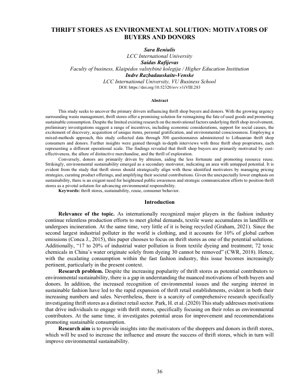
This study investigates the primary motivational drivers for individuals who engage with thrift stores, either as buyers or donors. Positioned within the urgent global context of textile waste and unsustainable fast fashion, the research aims to uncover how thrift stores can be strategically leveraged not just as charitable outlets, but as pivotal actors in promoting environmental sustainability. The core problem addressed is the gap in understanding the nuanced motivations behind thrift store participation, which is critical for enhancing their impact and scaling their role in the circular economy.
Research Aim: To provide insights into the motivators of shoppers and donors to increase the influence and success of thrift stores, thereby improving environmental sustainability.
Key Objectives:
- Analyze the concept of thrift shops and previous research on motivators.
- Examine thrift shop donors and shoppers in Lithuania via survey to identify their motivators.
- Provide recommendations for motivating increased public engagement with thrift stores.
2. Literature Review & Conceptual Framework
2.1 The Environmental Imperative of Textile Waste
The fashion industry is a major polluter, accounting for approximately 10% of global carbon emissions and 20% of industrial water pollution. Vast quantities of textile waste end up in landfills or are incinerated, with minimal recycling rates. This creates a pressing environmental need for solutions that extend product lifecycles.
2.2 Thrift Stores: Beyond Charity to Environmental Solution
While traditionally viewed as venues for affordable goods aiding low-income populations, thrift stores are increasingly recognized for their environmental function. They facilitate reuse, divert waste from landfills, and reduce demand for new resource-intensive production.
2.3 Gap in Motivational Research
Despite growing popularity, comprehensive research specifically targeting the motivational drivers for both buyers and donors in the thrift store sector remains scarce. Preliminary studies suggest a spectrum including economic factors, support for social causes, treasure-hunt excitement, and environmental consciousness, but these lack depth and regional specificity.
3. Research Methodology
3.1 Mixed-Methods Approach
The study employed a mixed-methods design, combining quantitative and qualitative data to gain a holistic understanding. This approach allows for statistical generalization from survey data and rich, contextual insights from interviews.
3.2 Data Collection: Surveys & Interviews
Quantitative: 300 questionnaires administered to Lithuanian thrift shop consumers and donors.
Qualitative: In-depth interviews with three thrift shop proprietors representing different operational scales (small, medium, large).
4. Results & Key Findings
Core Motivators at a Glance
Buyers: Cost-effectiveness, Unique Finds, Thrill of Exploration.
Donors: Altruism, Helping Others, Promoting Reuse.
Surprise Finding: Environmental sustainability ranked as a secondary motivator for both groups.
4.1 Motivators of Thrift Shop Buyers
The primary drivers for shoppers are pragmatic and experiential:
- Economic Value (Cost-effectiveness): The primary motivator, appealing to budget-conscious consumers.
- Uniqueness & Discovery: The allure of finding distinctive, vintage, or one-of-a-kind items not available in conventional retail.
- The "Treasure Hunt" Experience: The excitement and personal gratification derived from the search and discovery process.
4.2 Motivators of Thrift Shop Donors
Donor behavior is predominantly driven by prosocial and practical considerations:
- Altruism & Helping the Less Fortunate: The desire to contribute to social welfare by providing affordable goods to those in need.
- Convenience & Waste Reduction: A practical desire to declutter and ensure items are reused rather than discarded.
- Supporting a Cause: Aligning with the charitable or community mission of the thrift store organization.
4.3 The Secondary Role of Environmental Sustainability
A critical and somewhat counterintuitive finding was that environmental sustainability was not a primary motivator for either group. While acknowledged, it acted as a supporting rationale rather than a core driver. This indicates a significant gap between the potential environmental impact of thrift stores and consumer/donor awareness or prioritization of this impact.
5. Discussion & Strategic Implications
5.1 Aligning Operations with Core Motivators
Thrift stores must strategically cater to identified primary drivers:
- For Buyers: Manage pricing strategies to maintain perceived value, curate product assortments to enhance the "treasure hunt," and improve store layout for better exploration.
- For Donors: Streamline donation processes, clearly communicate how donations help the community, and provide convenient drop-off options.
5.2 The Communication Gap on Sustainability
The study reveals an urgent need for strategic communication. Thrift stores must actively educate the public on their environmental role. This involves quantifying and messaging the environmental benefit (e.g., "This purchase saved X kg of CO2"), akin to lifecycle assessment communication strategies seen in other industries. This can help elevate sustainability from a secondary to a primary motivator.
6. Analytical Framework & Case Example
Analyst's Perspective: Core Insight, Logical Flow, Strengths & Flaws, Actionable Insights
Core Insight: The Lithuanian thrift market is currently powered by transactional and emotional drivers (saving money, feeling good) rather than ideological ones (saving the planet). The environmental value proposition is an underutilized asset sitting on the shelf.
Logical Flow: The research correctly identifies a macro problem (textile waste), proposes a micro-solution (thrift stores), and drills down to the behavioral engine (motivation). Its logic chain is solid: to scale the solution, you must understand what fuels participation. The mixed-methods approach provides both the "what" (survey stats) and the "why" (interview nuances).
Strengths & Flaws: The strength lies in its clear, actionable segmentation of buyer vs. donor motivators—this is immediately useful for store managers. The major flaw is its regional limitation (Lithuania); motivations in a mature second-hand market like the US or Western Europe, where "thrifting" is often a lifestyle choice, likely differ significantly. The study also hints at but doesn't deeply explore the potential demotivators (e.g., stigma, hygiene concerns, time cost) which are equally critical for strategy.
Actionable Insights: For thrift store operators, the playbook is clear: Double down on your core value. For buyers, amplify the treasure hunt through better visual merchandising and social media showcasing unique finds. For donors, make donating as easy as online shopping returns. Crucially, launch an "Environmental Impact" marketing campaign. Calculate a simple metric like carbon/water savings per item and tag every product with it, transforming an abstract benefit into a tangible feature. Partner with fast-fashion brands for take-back schemes, reframing donation as the "cool" end-of-life for any garment.
7. Future Applications & Research Directions
- Technology Integration: Develop apps that track personal environmental impact (e.g., carbon footprint reduced) through thrift purchases/donations, gamifying sustainable behavior.
- Cross-Sector Partnerships: Thrift stores partnering with fast-fashion brands for official recycling/reshaping programs, creating a closed-loop system.
- Product Lifecycle Analysis (LCA) Tools: Implementing simplified LCA to provide consumers with quantifiable environmental savings per item, a concept supported by frameworks like the ISO 14040 series.
- Global Comparative Studies: Expanding research to different cultural and economic contexts to build a universal model of thrift store engagement motivators.
- Behavioral Nudge Research: Investigating how store layout, pricing cues (e.g., "Planet Saver Price"), and messaging can nudge consumers towards more sustainable choices without compromising core economic motivators.
8. References
- Beniulis, S., Rafijevas, S., & Razbadauskaite-Venske, I. (n.d.). Thrift Stores as Environmental Solution: Motivators of Buyers and Donors. Journal of Sustainable Business.
- Conca, J. (2015). Making Climate Change Fashionable - The Garment Industry Takes On Global Warming. Forbes.
- Graham, H. (2021). The Environmental Crisis in Your Closet. Bloomberg Green.
- Park, H., et al. (2020). Motivations for Patronizing Thrift Stores: A Comparative Study. Journal of Consumer Behaviour.
- Selmys, M. (2016). The Socio-Economic Role of Modern Thrift Stores. International Journal of Nonprofit Sector.
- ISO 14040:2006. Environmental management — Life cycle assessment — Principles and framework. International Organization for Standardization.
- Ellen MacArthur Foundation. (2017). A New Textiles Economy: Redesigning Fashion's Future. https://www.ellenmacarthurfoundation.org/