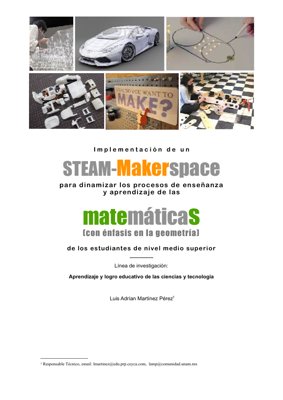
1. Project Overview
This project proposes the implementation of a STEAM-Makerspace to revitalize the teaching and learning processes of mathematics, with a specific emphasis on geometry, for second-year high school students. The initiative is a direct response to identified deficiencies in mathematical competencies among graduates, aiming to leverage hands-on, interdisciplinary learning to improve academic outcomes and cognitive development.
Project Lead: Luis Adrián Martínez Pérez
Affiliation: Colegio Ceyca / Universidad Nacional Autónoma de México (UNAM)
Contact: lmartinez@edu.prp.ceyca.com, lamp@comunidad.unam.mx
2. Research Line
The project falls under the research line of "Learning and Educational Achievement in Science and Technology." It focuses on pedagogical innovation to bridge the gap between theoretical knowledge and practical application, particularly in STEM fields.
3. Theoretical Background
The proposal is grounded in a recognition of the fundamental role of mathematics in scientific, humanistic, and artistic thought, as well as in daily life.
3.1 The Importance of Mathematics and Patterns
The document opens with Plato's famous dictum, "Let no one ignorant of geometry enter," and cites Marjorie Senechal on the ubiquity and importance of patterns. It argues that the ability to recognize, interpret, and create patterns is essential for engaging with the world. This establishes a philosophical and cognitive foundation for prioritizing geometry and spatial reasoning.
3.2 The National Educational Problem
The proposal identifies a critical national issue: significant deficiencies in the mathematical knowledge and skills of high school graduates, as evidenced by national (PLANEA) and international (PISA) assessment results. The author argues that this deficit negatively impacts students' future intellectual, professional, and personal development. The STEAM-Makerspace is positioned within the institution's broader Educational Project for the Science Area as a radical response to this problem.
Key Data Points Cited
- Reference to PLANEA (2015-2017) and PISA (2015-2016) results for Mexico.
- Internal analysis of PLANEA and College Board results within Colegio Ceyca.
- Historical analysis of mathematics education reforms from the 1960s-1980s.
3.3 The Decline of Geometry in Curricula
A central thesis of the proposal is that a key cause of the mathematics problem is the diminished role of geometry in school curricula following reforms from the 1960s to 1980s. The author, supported by documented evidence and teaching experience, contends that this marginalization has led to a poor understanding of mathematics overall and consequently to low academic performance.
4. Core Insight & Analyst's Perspective
Core Insight
This proposal isn't just about adding a 3D printer to a classroom; it's a targeted surgical strike on a systemic flaw in mathematics pedagogy. The core insight is that the abstraction of modern math curricula, particularly the sidelining of geometry, has severed the vital link between mathematical concepts and tangible, spatial reality. The makerspace is conceived not as a tech playground, but as a cognitive re-anchoring tool, using physical construction and design to rebuild the foundational spatial reasoning that underpins advanced mathematical and scientific thought.
Logical Flow
The argument follows a compelling, cause-and-effect chain: 1) National test scores (PLANEA/PISA) reveal a math crisis. 2) Root cause analysis points to curriculum reforms that minimized geometry. 3) Geometry's decline weakens spatial reasoning and the understanding of patterns/form. 4) This deficiency hampers performance across STEM. 5) Therefore, reintroducing geometry through hands-on, integrated STEAM experiences (the makerspace) is the logical corrective intervention. The flow from problem identification to a specific, theory-backed solution is clear and defensible.
Strengths & Flaws
Strengths: The proposal's greatest strength is its diagnostic precision. Instead of vaguely advocating for "more technology," it identifies a specific historical-pedagogical wound (the loss of geometry) and prescribes a specific treatment. Linking the intervention to spatial cognition theory, as explored in works like "Thinking, Fast and Slow" by Daniel Kahneman regarding System 1/System 2 thinking, or research from the National Science Foundation on spatial learning, would strengthen this further. The focus on a defined student cohort (second-year high school) also makes it actionable.
Critical Flaw: The proposal is conspicuously silent on assessment methodology. How will success be measured? Pre/post spatial reasoning tests (e.g., Mental Rotation Tests)? Comparative analysis of geometry exam scores? Qualitative assessment of student engagement and project complexity? Without a robust, pre-defined evaluation framework, the project risks becoming another well-intentioned but unproven initiative. The reference to internal college analyses is a start, but not a plan.
Actionable Insights
1. Pilot with Metrics First: Before full rollout, run a controlled pilot with a clear control group. Primary metric: improvement in standardized geometry problem-solving. Secondary metrics: student and teacher feedback, project completion rates.
2. Curriculum Integration, Not Isolation: The makerspace must not be an island. Develop explicit lesson modules that tie maker projects (e.g., building a parabolic solar cooker) directly to algebra and calculus concepts, creating a feedback loop between the concrete and the abstract.
3. Teacher as Designer, Not Technician: Professional development is key. Training should focus on pedagogical design—how to craft projects that elicit specific geometric reasoning—not just on how to operate laser cutters. Leverage frameworks like TPACK (Technological Pedagogical Content Knowledge).
4. Seek External Validation: Partner with a local university's education or psychology department to conduct a formal study. This generates publishable data and elevates the project from a school initiative to a contribution to educational research.
5. Technical Details & Mathematical Framework
The proposal implicitly advocates for a pedagogical framework where geometric principles are discovered and applied through construction. A potential technical workflow could involve:
- Problem Definition: A real-world challenge is presented (e.g., design a bridge with a specific span using limited materials).
- Geometric Modeling: Students transition to abstract modeling. This involves applying formulas for area, volume, and structural integrity. For instance, calculating the cross-sectional area of a beam relates to its strength: $\sigma = \frac{F}{A}$, where $\sigma$ is stress, $F$ is force, and $A$ is area.
- Digital Fabrication: Designs are translated into digital files for fabrication (3D printing, laser cutting). This step reinforces coordinate geometry ($(x, y, z)$ coordinates) and transformations (translation, rotation, scaling).
- Physical Assembly & Testing: The constructed object is tested against criteria. Failure analysis leads back to geometric and mathematical refinement (e.g., "The bridge sagged because our truss angles were inefficient, let's recalculate using trigonometric principles for optimal angle $\theta$").
This creates an iterative Design-Build-Test-Learn cycle grounded in mathematical application.
6. Experimental Results & Data Analysis
Note: The provided PDF excerpt does not contain results from the proposed makerspace, as it is a project proposal. The following describes the intended experimental approach and expected outcomes based on the proposal's goals.
The project's success would be evaluated through a mixed-methods approach:
- Quantitative Metrics:
- Pre- and post-assessment scores on standardized geometry and spatial reasoning tests (e.g., a subset of PLANEA math items focused on geometry).
- Comparison of final grades in mathematics courses between a cohort with makerspace access and a control cohort without.
- Tracking the complexity and mathematical sophistication of student projects over time (e.g., moving from 2D shapes to 3D models requiring calculus for volume optimization).
- Qualitative Metrics:
- Student surveys and interviews assessing changes in attitude towards mathematics (reduced anxiety, increased perception of relevance).
- Teacher observations and reflective journals documenting student engagement and collaborative problem-solving behaviors.
- Analysis of student project portfolios for evidence of iterative design and application of mathematical concepts.
Expected Chart: A bar chart comparing the average gain in geometry test scores for the intervention group (Makerspace) versus the control group (Traditional Instruction). The hypothesis, based on the proposal's rationale, would be a significantly larger gain for the intervention group.
7. Analysis Framework: A Non-Code Case Study
Case: The "Optimal Container" Project
Learning Objective: Apply concepts of surface area, volume, derivatives, and optimization to design a physical container with minimal material use for a given volume.
Framework Application:
- Context & Problem: "A company needs a cylindrical container to hold 1 liter of liquid. To minimize cost, they want to use the least amount of material (metal/plastic) possible. Design this container."
- Mathematical Abstraction:
- Define variables: Let $r$ = radius, $h$ = height. Volume constraint: $V = \pi r^2 h = 1000\, cm^3$.
- Surface area (material) to minimize: $A = 2\pi r^2 + 2\pi r h$.
- Use the volume constraint to express $h$ in terms of $r$: $h = \frac{1000}{\pi r^2}$.
- Substitute into area formula: $A(r) = 2\pi r^2 + \frac{2000}{r}$.
- Optimization: Find the critical point by taking the derivative and setting it to zero:
$\frac{dA}{dr} = 4\pi r - \frac{2000}{r^2} = 0$.
Solve for $r$: $4\pi r^3 = 2000 \Rightarrow r = \sqrt[3]{\frac{500}{\pi}} \approx 5.42\, cm$.
Then find $h \approx 10.84\, cm$. Note: $h = 2r$, the optimal ratio.
- Physical Realization (Makerspace): Students use CAD software to model the cylinder with the calculated dimensions, then fabricate it using 3D printing or assemble it from laser-cut acrylic. They physically measure its volume to verify it holds ~1 liter.
- Analysis & Reflection: Students compare their optimized design to a non-optimal one (e.g., a tall, skinny cylinder). They calculate the percentage of material saved and discuss the real-world implications for sustainability and cost. The tangible model solidifies the abstract calculus procedure.
This case demonstrates how the makerspace acts as the "proof of concept" for abstract mathematics, closing the learning loop.
8. Future Applications & Development Directions
The STEAM-Makerspace model proposed has significant potential for scaling and evolution:
- Vertical Integration: Extend the model to other mathematical domains (e.g., statistics via data physicalization projects, algebra through robotic motion programming).
- Cross-Disciplinary Expansion: Develop integrated projects with Physics (building trebuchets for projectile motion), Biology (designing efficient leaf-inspired solar panels), or Art (creating algorithmic art and sculptures based on fractal geometry).
- Technology Convergence: Incorporate Augmented Reality (AR) to overlay geometric formulas and force vectors onto physical models during construction, or use sensors and microcontrollers (e.g., Arduino) to collect and analyze data from student-built mechanisms, integrating coding and data science.
- Community & Industry Links: Partner with local industries to present real-world engineering challenges. Engage the community through exhibitions of student projects, demonstrating the practical value of mathematical learning.
- Research Platform: As suggested in the analyst's perspective, the space can become a living lab for educational research, contributing to the global understanding of embodied cognition and technology-enhanced learning in mathematics.
9. References
- Avila, A. (2016). Historical perspective on mathematics education in Mexico. [Reference from PDF].
- National Institute for Educational Evaluation (INEE) / SEP. (2015-2017). PLANEA Assessment Results. Retrieved from http://planea.sep.gob.mx/
- OECD. (2015). PISA 2015 Results: Mexico. Retrieved from https://www.oecd.org/pisa/
- Senechal, M. (2004). Forma. La enseñanza agradable de las matemáticas. Limusa. [Cited in PDF].
- Kahneman, D. (2011). Thinking, Fast and Slow. Farrar, Straus and Giroux. [External source on cognitive systems].
- Mishra, P., & Koehler, M. J. (2006). Technological Pedagogical Content Knowledge: A Framework for Teacher Knowledge. Teachers College Record, 108(6), 1017-1054. [External framework for teacher training].
- National Science Foundation. (n.d.). Science of Learning: Spatial Thinking. Retrieved from nsf.gov [Example of authoritative external research].
- Uttal, D. H., et al. (2013). The malleability of spatial skills: A meta-analysis of training studies. Psychological Bulletin, 139(2), 352–402. [External meta-analysis supporting spatial training].