1. Introduction & Overview
This document analyzes the speculative design proposal for "Redycler," a conceptual home appliance intended to revolutionize personal fashion and combat textile waste. The core idea is an automated device that uses re-programmable, multi-color photochromic dyes and controlled light exposure to alter the patterns and colors of existing garments, effectively "revitalizing" them without physical disposal or new material production.
The proposal positions Redycler at the intersection of Human-Computer Interaction (HCI), sustainable design, and personal fabrication, aiming to lower the barrier for users to modify clothing and express personal style while promoting a circular fashion economy.
2. The Redycler Appliance: Concept & Design
The Redycler is envisioned as a box-like appliance for the bedroom, automating the process of re-dyeing textiles.
2.1 Core Technology: Photochromic Dyes
The system's foundation is colored photochromic dyes activated by specific wavelengths of ultraviolet (UV) light. A key proposed mechanism is the selective deactivation of hues using complementary colors of visible light to achieve the final desired pattern. This implies a subtractive color model where broad-spectrum activation is followed by targeted deactivation.
2.2 User Interaction & Workflow
The proposed interaction is designed to be simple and integrated into daily life. A user would:
- Place a garment (e.g., an old t-shirt) into the appliance.
- Select or design a new pattern/color scheme via a connected app or interface.
- Initiate the cycle. The appliance would then expose the garment to UV light to activate the base dye state, followed by precise application of complementary visible light to "erase" or modify specific areas, creating the new design.
- Retrieve the revitalized garment.
2.3 Integration into Home Routines
The design speculates on embedding this novel technology into familiar domestic routines, akin to doing laundry. The goal is to make personal fabrication as effortless as using a washing machine, thereby encouraging regular use and sustained engagement with one's existing wardrobe.
3. Addressing Fast Fashion: The Sustainability Imperative
The proposal is framed as a direct response to the environmental crisis fueled by the fast fashion industry.
The Fast Fashion Problem: Key Statistics
- 8-10% of global CO₂ emissions.
- 79 trillion litres of water consumed annually.
- 92 million tons of textile waste produced each year.
- Average garment lifespan: 3.1 - 3.5 years.
- Only 15% of textile waste is recycled globally.
Source: Cited from the PDF, referencing [13].
3.1 The Problem: Textile Waste & Carbon Emissions
The fashion industry's linear model (take-make-dispose) and accelerated trend cycles (e.g., Shein's 3-day design-to-shipment goal) create immense pressure for constant consumption and disposal. This results in the staggering environmental footprint outlined above.
3.2 The Redycler's Proposed Solution
Redycler aims to disrupt this cycle by elongating the active life of individual garments. By enabling easy, non-destructive modification, it seeks to:
- Reduce the demand for new textile production.
- Divert clothing from landfills.
- Empower consumers to refresh their style sustainably, aligning with values of self-expression through personal styling [5].
4. Technical Deep Dive & Analysis
4.1 Technical Details & Mathematical Model
While the PDF is a speculative design, we can extrapolate the underlying photochemistry. The dye's color state $C$ could be modeled as a function of light exposure $E(\lambda, t)$, where $\lambda$ is wavelength and $t$ is time. Activation by UV light ($\lambda_{UV}$) might drive a reaction from a colorless state $A$ to a colored state $B$:
$A \xrightarrow[\text{h}\nu_{\lambda_{UV}}]{} B$
Deactivation by complementary visible light ($\lambda_{vis}$) would then reverse the process in targeted areas:
$B \xrightarrow[\text{h}\nu_{\lambda_{vis}}]{} A$
The final pattern $P(x,y)$ on the textile coordinate $(x,y)$ would be determined by the spatiotemporal integral of the light exposure mask $M(x,y,\lambda, t)$:
$P(x,y) = \int_{t} \int_{\lambda} \, M(x,y,\lambda, t) \, \cdot \, S(\lambda) \, d\lambda \, dt$
where $S(\lambda)$ is the spectral sensitivity of the dye. Precise control requires a DLP projector or laser scanning system for $M(x,y,\lambda, t)$.
4.2 Experimental Framework & Hypothetical Results
Hypothetical Experimental Setup: A benchtop prototype would consist of a UV LED array for blanket activation, a digital light projector (DLP) for patterned visible light deactivation, and a sample holder for fabric swatches coated with prototype photochromic dyes.
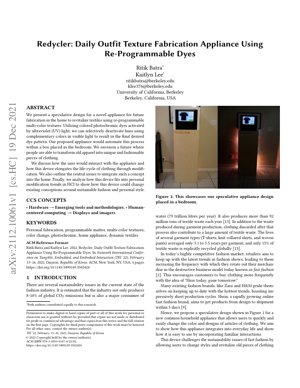
Hypothetical Chart Description (Figure 1 in PDF): The figure likely shows a rendered image of the speculative appliance—a sleek, box-like unit placed in a bedroom setting. It visually communicates the integration of a novel technology into a familiar domestic context, emphasizing usability and routine adoption.
Key Hypothetical Metrics for Success:
- Color Gamut & Saturation: Achievable range and intensity of colors from the dyes.
- Resolution & Edge Sharpness: Minimum feature size of the printed pattern.
- Cycle Durability: Number of re-programming cycles before dye degradation.
- Energy Consumption: Per-cycle energy use compared to manufacturing a new garment.
4.3 Analysis Framework: A Speculative Case Study
Scenario: Evaluating Redycler's potential impact on a user's annual carbon footprint related to clothing.
Framework:
- Baseline (Fast Fashion Consumer): User buys 5 new graphic t-shirts/year. Carbon cost = $5 \times \text{CO}_2\text{eq per new t-shirt (approx. 10 kg)}$ = 50 kg CO₂eq/year.
- Intervention (Redycler User): User buys 2 durable plain t-shirts initially. Uses Redycler to re-pattern them 10 times over 2 years. Carbon cost includes:
- Initial production: $2 \times 10 \text{ kg} = 20 \text{ kg CO₂eq}$
- Redycler operation: $10 \times \text{CO}_2\text{eq per cycle (est. 0.5 kg)}$ = $5 \text{ kg CO₂eq}$
- Total over 2 years: 25 kg CO₂eq. Annualized = 12.5 kg CO₂eq/year.
- Result: A hypothetical 75% reduction in annual carbon footprint from t-shirt consumption, not accounting for water, waste, and microfiber pollution savings.
This simplified LCA (Life Cycle Assessment) framework highlights the transformative potential, contingent on the technology's real-world performance.
5. Critical Analysis & Industry Perspective
Core Insight: Redycler isn't just a gadget; it's a Trojan horse for a systemic shift. It cleverly repurposes the human desire for novelty—the very engine of fast fashion—and redirects it towards circularity. The real innovation is its proposed behavioral model: making sustainability an effortless, creative, and integrated daily habit, not a sacrifice.
Logical Flow: The argument is sound: 1) Fast fashion is an environmental disaster. 2) People crave newness. 3) Therefore, decouple newness from new physical stuff. The proposed technical path (photochromic dyes + light projection) is a plausible, though highly ambitious, route to achieve this decoupling. It logically extends trends in HCI towards democratizing fabrication [16] and programmable matter.
Strengths & Flaws:
Strengths: The focus on domestic integration and familiar interaction is its masterstroke. It learns from the failure of many eco-products that require significant lifestyle changes. The connection to self-expression [5] is powerful and marketable.
Glaring Flaws: The paper is entirely speculative, bordering on science fiction with current materials science. The durability, wash-fastness, and cost of multi-color, high-resolution, reversible photochromic dyes for textiles are monumental hurdles—far beyond the state-of-the-art shown in research like that on photochromic microcapsules. The energy and complexity of the optical system are hand-waved. It also naively assumes the main barrier to sustainable fashion is consumer capability, ignoring powerful economic drivers like low garment prices and social signaling.
Actionable Insights: For researchers and investors, don't chase the full appliance vision yet. De-risk the technology. Fund foundational materials science: develop a single, durable, reversible dye first. For the HCI community, the paper's greatest contribution is its interaction paradigm—this "easy refresh" model can be applied to other domains (e.g., phone cases, furniture covers) with more near-term technologies. For the fashion industry, the takeaway is that the winning sustainable solution will likely be one that competes on experience and creativity, not just ethics.
6. Future Applications & Research Directions
The Redycler concept opens several avenues beyond personal apparel:
- Commercial & Rental Fashion: Rapid, non-destructive refurbishment of rental garments or retail display items between seasons or customers.
- Interior Design & Soft Furnishings: Dynamically changing curtains, upholstery, or bedding patterns to match mood or season.
- Accessibility & Adaptive Clothing: Allowing users to easily adjust the visual contrast or patterns on clothing for low-vision needs, or to customize medical wear.
- Gaming & VR/AR Integration: Physical garments that can change appearance to match a digital avatar or in-game character in real-time, bridging physical and digital fashion ("phygital").
Critical Research Directions:
- Material Science First: Primary research must focus on developing stable, vibrant, fatigue-resistant photochromic or other reversible color-change dyes suitable for home laundry conditions.
- Hybrid Approaches: Combine digital projection for temporary changes with more permanent but low-energy digital printing techniques for longer-term designs.
- AI-Driven Design: Integrate generative AI models (like adaptations of StyleGAN or tools from arXiv) to help users generate personalized, aesthetically coherent patterns from simple prompts, lowering the creativity barrier further.
- Lifecycle Assessment (LCA): Rigorous, peer-reviewed LCA studies are needed to compare the true environmental impact of such a system against conventional garment production and disposal.
7. References
- Batra, R., & Lee, K. (2022). Redycler: Daily Outfit Texture Fabrication Appliance Using Re-Programmable Dyes. In TEI '22: Proceedings of the Sixteenth International Conference on Tangible, Embedded, and Embodied Interaction.
- Bick, R., Halsey, E., & Ekenga, C. C. (2018). The global environmental injustice of fast fashion. Environmental Health, 17(1), 92.
- Zhu, J., Park, T., Isola, P., & Efros, A. A. (2017). Unpaired Image-to-Image Translation using Cycle-Consistent Adversarial Networks. In Proceedings of the IEEE International Conference on Computer Vision (ICCV). (CycleGAN reference for style transfer concepts).
- Karrer, T., Wittenhagen, M., & Borchers, J. (2011). The Drill Sergeant: Supporting Physical Health and Fitness through a Shape-Changing Duffel Bag. In Proceedings of the 13th International Conference on Ubiquitous Computing (UbiComp '11). (Example of HCI integrating behavior change into domestic objects).
- Meyer, M., & Sims, K. (2019). Crafting, Computation, and Collaboration: Framing the Ethics of DIY and Maker Culture. Proceedings of the ACM on Human-Computer Interaction, 3(CSCW).
- Ellen MacArthur Foundation. (2017). A new textiles economy: Redesigning fashion’s future. https://www.ellenmacarthurfoundation.org/publications. (Authoritative source on fashion sustainability).
- Berzowska, J. (2005). Electronic textiles: Wearable computers, reactive fashion, and soft computation. Textile, 3(1), 58-75.
- United Nations Environment Programme (UNEP). (2019). Sustainability and Circularity in the Textile Value Chain. UNEP Publications.
- Report on Shein's business model (as cited in PDF [9]).
- Source for global textile waste statistics (as cited in PDF [13]).